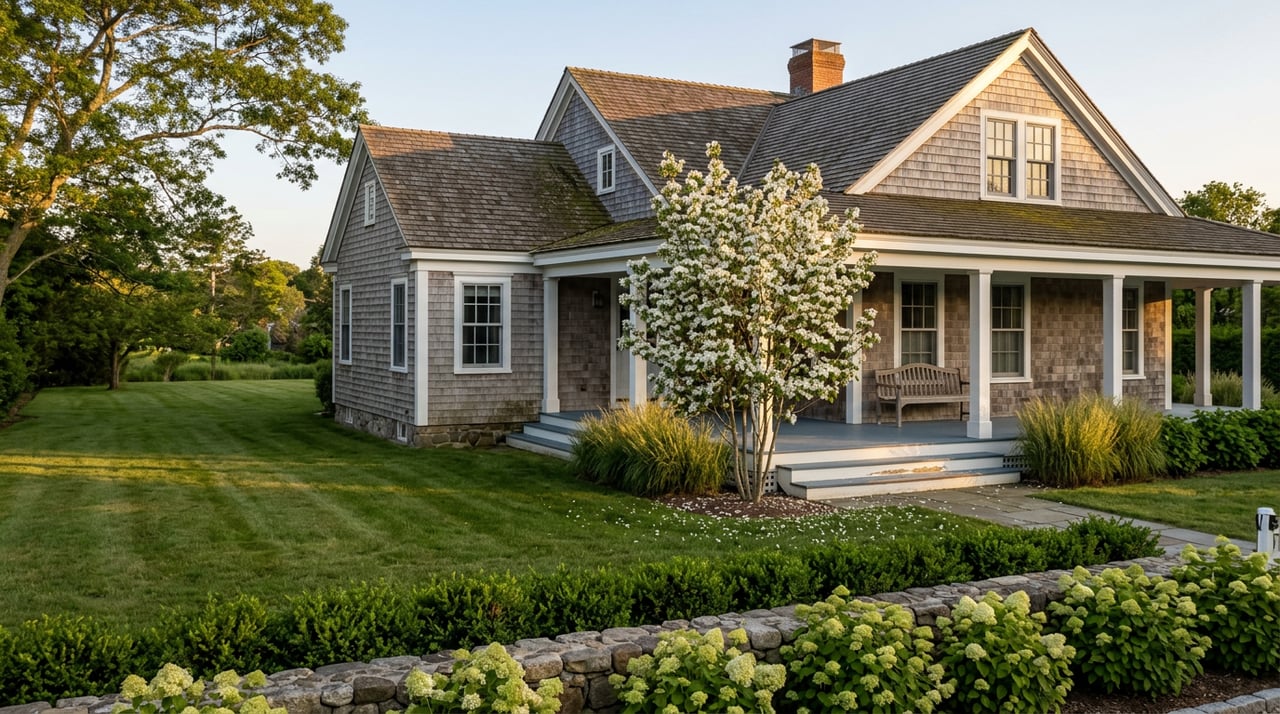
Why Rockport's Most Scenic Streets Are the Hardest to Finance
September 3, 2026
September 3, 2026
At the end of South Street in Rockport, past a plaque marking Samuel de Champlain's 1605 landing, a sign warns visitors off Whale Cove Landing: Private Road. Walk past the old horse farm and you can still reach the water on foot. Drive past it and you risk a tow. It is one sign, but it captures something true about a meaningful share of Cape Ann's most desirable addresses. The road that gets you to the view is not, in the eyes of the town, a public road at all.
Rockport's coastline carries that same rough-edged, thinly maintained character down plenty of lanes that never got a sign. Marmion Way may be the most photographed street in town, the place locals go to watch a nor'easter throw spray over the granite, and it wears the look of a road nobody with public works funding has ever smoothed out. Eden Road, a short walk from Flat Ledges and within sight of Thacher Island's twin lighthouses, has a similar reputation among residents, who by local account prefer it left rough so through traffic stays away. Charming, until you are the one trying to finance the house at the end of it.
Buyers assume a private road means a shared plowing bill and a slightly bumpier driveway. On Rockport's coastline, it can mean something with more teeth: a financing condition that shows up late in a transaction, on exactly the homes priced high enough to need it.
Every year the Federal Housing Finance Agency resets the ceiling on what counts as a conforming loan, the kind Fannie Mae and Freddie Mac will buy, and typically the kind that comes with the friendliest rates and the lightest underwriting. For 2026, Essex County, which includes Rockport, sits in the high cost tier at $962,550 for a single family home. That is real headroom, well above the $832,750 baseline that applies across most of the country and much of western Massachusetts.
The moment a Rockport waterfront or near-waterfront purchase, whether on Marmion Way, Eden Road, or anywhere else along the coast, crosses that number, the loan stops being conforming and becomes jumbo. Jumbo loans are not just pricier. They are underwritten by private investors who evaluate collateral risk on their own terms, and one item they check for almost without exception is a signed, recorded agreement spelling out who maintains the road the house sits on.
That is the detail nobody raises at the open house, and it is the one that can stall a closing weeks later.
Massachusetts holds thousands of private ways across the state, and Rockport's own planning documents describe its transportation network plainly as a mix of public and private streets, State Route 127, and the commuter rail line, all threaded together along a small coastal footprint. Whale Cove Landing is the clearest, sign-posted example. Eden Road's reputation for potholes over pavement and Marmion Way's standing as the town's favorite storm-watching perch are exactly the kind of local color that grows up around a road the town has no legal authority to touch. It is worth separating two things that get conflated on first read.
The town's Rights of Way Committee, a permanent body since 1989, protects public footpaths that happen to cross private land, including the Atlantic Path along the headlands. That is a foot access question. It has nothing to do with who pays to fix the pavement.
Road maintenance is a different question entirely, and Massachusetts common law answers it plainly: the duty falls on whoever holds the fee in the private way, and absent a deed provision or a separately recorded agreement, no abutter is legally required to contribute to plowing, grading, or drainage repair, even if they drive the road daily. The Rockport Civic League has documented this directly, publishing the town's own private and public street plow list, because the Department of Public Works cannot legally send a crew onto private property without permission first. Massachusetts law does let a town vote to plow private ways that are open to public use, but that vote is optional, not automatic, and it does nothing to establish who pays for a collapsed culvert or a resurfacing project.
Compare that to Maine, one state up the coast, where a private ways statute requires abutters to share the cost of reasonable repairs equally even without a written agreement. Massachusetts has no equivalent law. Here, the agreement exists on paper or it does not exist at all.
| Massachusetts | Maine | |
|---|---|---|
| Default rule with no written agreement | No obligation to share maintenance costs | Abutters must share costs equally by statute |
| What creates a legal duty | A recorded maintenance agreement or deed provision | The statute itself |
| What a lender finds without one | An unresolved collateral question | A built-in backstop |
A conforming loan under Essex County's $962,550 ceiling can sometimes move through underwriting without the private way question ever surfacing directly. A jumbo loan rarely gets that pass. Once a mortgage crosses into jumbo territory, the investor purchasing that loan is taking on the collateral risk directly, and a house whose only access road has no documented maintenance plan is harder to lend against and harder to resell if the loan is ever called.
That is where a quiet gap in Massachusetts property law turns into a live closing problem. A buyer's attorney doing title work on a Marmion Way or Eden Road property should be checking early whether a Private Road Maintenance Agreement exists and is recorded at the registry of deeds. If it is not there, the lender may require one before the loan can close, and getting a handful of coastal property owners to agree on a maintenance formula under a contract deadline is rarely quick. In the worst version of this, one abutter who declines to sign can leave a well located, well built home financeable only to a cash buyer, because no conventional lender will fund a loan against an access road with an open dispute attached to it.
If your home sits on one of Rockport's private ways and you plan to list above the conforming ceiling, the maintenance agreement question is worth resolving before a buyer's attorney raises it mid-contract. A recorded agreement in place ahead of listing keeps your buyer pool open to anyone who qualifies for jumbo financing, rather than narrowing it to whoever can pay in cash or absorb the delay of getting neighbors to sign off under deadline pressure. It is a paperwork step, not a renovation, and it costs a fraction of what a stalled closing costs in carrying charges and lost momentum.
If you are buying, ask the question at the offer stage, not at the closing table. A seller or listing agent who can point to a recorded agreement, or who tells you plainly that one does not exist, is handing you information that changes your financing timeline before you are locked into a contract. This is not a defect to be embarrassed about. It is a fact about the property, the same category as a well or a septic system, and it deserves the same early attention those get.
Rockport's coastal streets sell themselves the moment a buyer sees the water from the porch. The harder part is a piece of paper that decides who can actually finance the house looking at that view, and it sits quietly in a registry of deeds, not in the listing photos. Buyers who ask about it before writing an offer save themselves weeks. Sellers who resolve it before the sign goes up keep their buyer pool as wide as the view itself.
If you are weighing a purchase or a sale on one of Rockport's private ways, Jamie Frontiero works through exactly this kind of contract detail with clients across Cape Ann and the North Shore. Let's Connect before you write the offer, not after.
Stay up to date on the latest real estate trends.





Jamie offers a concierge line of Real Estate services for Buyers & Sellers throughout the MA North Shore & NH Seacoast. With a personal approach, she combines local market knowledge and contract expertise to ensure a smooth and successful transaction.
JAMIE FRONTIERO
(603) 205-4705
[email protected]
12 Federal Street
Newburyport, MA 01950